
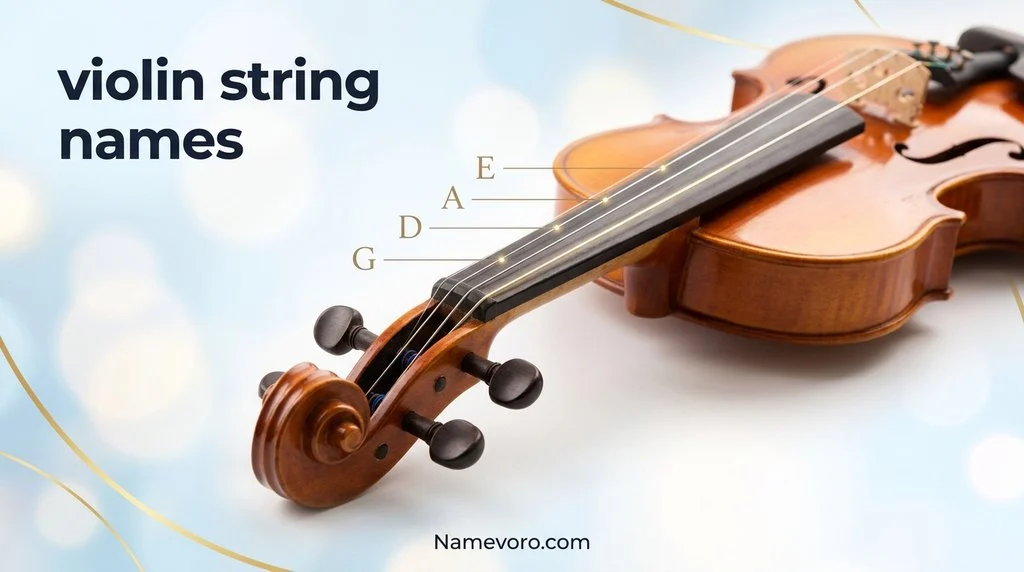
A violin has just four strings, but knowing their names is one of the first steps toward playing music with confidence.
If you’re learning the violin, reading sheet music, or trying to understand how your instrument works, the string names help you make sense of notes, tuning, and finger placement.
The four violin string names are G, D, A, and E, arranged from the thickest string to the thinnest. Each string has a different pitch, and together they give the violin its wide range of musical sounds.
Once you know their order, tuning your instrument and following a teacher’s instructions become much easier.
You don’t need advanced music theory to remember them. A simple pattern, a little practice, and a clear understanding of which string is which will get you started.
You’ll also learn why violinists use this particular tuning, how the strings relate to musical notes, and how to identify them while holding your violin.
Whether you’re a complete beginner, a parent helping a young musician, or simply curious about the instrument, this guide explains the essentials in plain English.
Featured Snippet Answer
The four violin string names are G, D, A, and E, ordered from the lowest pitch and thickest string to the highest pitch and thinnest string.
Their standard tuning notes are G3, D4, A4, and E5. These are called open strings because they produce their notes without pressing a finger against the fingerboard.
What Are the Four Violin String Names?
A standard violin has four strings, and each one has a specific name based on its open-string pitch. Learning these names gives you a useful starting point for tuning, practicing scales, and reading music.
| String name | Standard note | Pitch | General feel |
|---|---|---|---|
| G string | G3 | Lowest | Deep and warm |
| D string | D4 | Low-middle | Full and mellow |
| A string | A4 | High-middle | Clear and bright |
| E string | E5 | Highest | High and brilliant |
The number after each letter identifies its octave. For example, G3 is a lower G than G4. You may not need to remember the octave numbers at first, but they are useful when learning music theory.
1. G String
The G string is the thickest and lowest-pitched string on a standard violin. It often produces a rich, warm sound that works well for lower melodies and harmonies.
Beginners may find the G string helpful for exploring slow scales and simple tunes. Its lower sound is quite different from the bright tone of the E string.
2. D String
The D string is the second-lowest string, sitting between G and A in pitch. It has a full, balanced tone that works well for melodies, scales, and many beginner exercises.
Because it sits in the middle of the violin’s lower register, you’ll often use it when moving between notes on the G and A strings.
3. A String
The A string is the second-highest string and is tuned to A4. It is especially useful for learning familiar melodies and practicing basic finger patterns.
Violinists also use the A string as a tuning reference. The note A is commonly used to help tune orchestral instruments, so you’ll often hear it played before rehearsals.
4. E String
The E string is the thinnest and highest-pitched string on a standard violin. Its sound is bright and clear, making it useful for high melodies and notes that stand out above the other strings.
Because it is thinner and held at higher tension than many violin strings, it deserves careful handling during tuning. Turn the fine tuner or peg gently rather than making sudden adjustments.
What Is the Correct Order of Violin Strings?
The correct order from lowest to highest is:
G → D → A → E
Remember that this order follows pitch, not the alphabet. The G string sounds lowest, while the E string sounds highest.
Easy way to remember the order
G
D
Lower
A
Higher
E
Highest
Think of the sound climbing from a low G to a high E.
If you’re holding your violin, don’t rely only on which string looks closest to you. Learn the names alongside the sound and position of each string, and use a clear diagram or your teacher’s demonstration to confirm their physical arrangement.
A simple memory trick
Try the phrase “Good Dogs Always Eat.” The first letter of each word matches G, D, A, and E.
It is a simple way to recall the sequence when you are starting lessons. You can also say the four letters aloud each time you pick up your violin until the order feels automatic.
How Are Violin Strings Tuned?
Standard violin tuning uses the notes G3, D4, A4, and E5. Each string is tuned to its own target pitch so the instrument sounds correct when you play open strings or use your fingers on the fingerboard.
Use a violin tuner
An electronic tuner or violin tuning app can show whether a string is too high or too low. Pluck the string gently, or use a slow bow stroke, and adjust until the tuner identifies the correct note.
Know the difference between pegs and fine tuners
- Tuning pegs: Make larger pitch adjustments. Turn them slowly because a small movement can change the pitch significantly.
- Fine tuners: Make small, precise adjustments. They are especially helpful for beginners.
Many beginner violins have fine tuners on all four strings, while some instruments have fewer. Follow your teacher’s advice if you’re unsure how to use the pegs safely.
Tune one string at a time
Start with a reliable reference pitch, then check each string in the G–D–A–E order. Recheck the strings after making adjustments because changing one string’s tension can affect the others slightly.
If a string seems unusually tight, the peg slips repeatedly, or you hear a sharp cracking sound, stop rather than forcing it. A teacher or violin repair professional can check the instrument.
How Do Violin Strings Relate to Musical Notes?
The string name tells you the note produced by that string when it is played open. Pressing a finger against the fingerboard shortens the vibrating portion of the string and raises the pitch.
For example, an open A string plays A4. Pressing a finger down at the correct position can produce B4, C5, or other higher notes, depending on the finger placement.
Open strings versus fingered notes
| Playing method | What happens | Example |
|---|---|---|
| Open string | Play without pressing a finger | Open D produces D4 |
| Fingered note | Press a finger on the string | A fingered note on D can produce E4 |
| Higher position | Place the hand farther up the fingerboard | Produces higher notes |
The exact note depends on where the finger touches the string. Beginners usually start with simple finger patterns before learning higher positions.
Why the string names matter when reading music
Violin music is commonly written in treble clef. Knowing the open strings helps you connect written notes with physical movements on the instrument.
For instance, if your teacher asks you to play an open G, you know not to press a finger down. If the music calls for a higher note on the D string, you know which string to use and where to begin looking for the note.
A single note may sometimes be played on more than one string. The best choice depends on tone, fingering, and the notes that come before and after it.
How to Identify Each Violin String
Identifying the strings becomes easier when you combine what you hear with what you see. Start by learning one string at a time instead of trying to memorize everything during your first practice session.
Identify strings by thickness
The G string is generally the thickest, and the E string is the thinnest. The D and A strings fall between them. Thickness gives you a useful visual clue, although string materials and designs can vary.
Identify strings by sound
Pluck each open string gently and listen to how the pitch changes.
- G: Deep and low.
- D: Slightly higher than G.
- A: Higher than D.
- E: The highest of the four.
Repeat the sequence slowly. With practice, you’ll begin to recognize the sounds without checking a tuner every time.
Practice a quick string identification exercise
Choose an answer for each question to test your knowledge.
1. Which string produces the lowest open note?E stringG stringA string
2. Which string is tuned to A4?D stringE stringA string
3. Which is the thinnest standard violin string?G stringD stringE stringTry again
Are Violin Strings Different From Guitar Strings?
Yes. Both instruments use strings to create musical notes, but their string counts, tuning systems, and playing methods differ.
| Feature | Violin | Standard six-string guitar |
|---|---|---|
| Number of strings | 4 | 6 |
| Open-string order, low to high | G, D, A, E | E, A, D, G, B, E |
| Playing method | Bowing or plucking | Usually plucking or strumming |
| Common role | Melody and harmony | Melody, chords, and rhythm |
Notice that both instruments use some of the same note names. However, the violin’s open strings are tuned in fifths, while a standard guitar uses a different tuning pattern, mostly in fourths with one major-third interval.
This distinction matters if you’re learning both instruments. Knowing the name of a note doesn’t mean it appears on the same string or in the same physical position on each instrument.
How to Choose the Right Violin Strings
Once you know the four string names, you may start thinking about replacement strings. The right set depends on your instrument, playing level, sound preferences, and budget.
Consider your playing level
Beginners generally benefit from a reliable set that stays in tune reasonably well and responds predictably. You don’t need the most expensive strings to learn basic technique.
More experienced players may choose strings based on warmth, brightness, projection, or how quickly the strings respond to the bow.
Understand the main string types
- Steel-core strings: Often offer a clear response and stable tuning.
- Synthetic-core strings: Can provide a balanced tone with a range of sound options.
- Gut-core strings: Often valued for their complex tone, but they can be more sensitive to changes in temperature and humidity.
These are broad tendencies rather than guarantees. The sound also depends on the violin, bow, setup, and the player.
Check compatibility before buying
Make sure the strings are intended for your violin’s size. A full-size violin normally uses 4/4 strings, while smaller instruments need appropriately sized sets.
Replace damaged or worn strings promptly, and ask a teacher or violin technician for help if you’re unsure which set suits your instrument.
Common Mistakes Beginners Make
A few small misunderstandings can make early violin practice harder than it needs to be.
- Learning the order backward: Remember G–D–A–E from lowest to highest.
- Confusing a string name with every note on that string: The name refers to its open pitch. Fingered notes can be higher.
- Turning tuning pegs too quickly: Small adjustments are safer and easier to control.
- Assuming thicker always means better: String quality, material, and compatibility matter more than thickness alone.
- Ignoring unusual sounds: A buzzing string, slipping peg, or damaged string may need attention rather than repeated tuning.
One more useful tip: don’t try to memorize every note on the fingerboard on day one. First, learn the open strings, then add finger positions gradually. This gives you a solid foundation without making practice feel overwhelming.
FAQs About Violin String Names
1. What are the four violin strings called?
The four violin strings are G, D, A, and E. From lowest to highest pitch, the order is G, D, A, E. The G string is the thickest and lowest, while the E string is the thinnest and highest. These letters refer to the notes produced by the open strings. Learning them is a basic step in violin lessons because the names help you follow tuning instructions, practice exercises, and sheet music.
2. Which violin string is the highest?
The E string is the highest-pitched open string on a standard violin. It is also usually the thinnest of the four strings. Its standard tuning note is E5, which is higher than the open A4, D4, and G3 strings. The E string can also produce many higher notes when you press your fingers along the fingerboard. Beginners should tune it carefully because excessive tension can cause a string to break.
3. Which violin string is the thickest?
The G string is generally the thickest string on a standard violin. It produces the lowest open note, G3, and often has a warm, full sound. The D string is the next-lowest, followed by A and E. String thickness varies with the string’s design and material, so appearance alone is not always a perfect guide. Learning to recognize the G string by both its position and sound makes it easier to identify during practice.
4. Why are violin strings tuned G, D, A, and E?
The standard tuning gives the violin a useful range of pitches and allows players to perform melodies, scales, and harmonies across all four strings. Each adjacent open string is separated by a perfect fifth, meaning the tuning follows a consistent musical interval. This arrangement helps violinists move between strings while playing different notes. Although alternate tunings exist for certain musical styles, G3, D4, A4, and E5 are the standard open-string pitches taught to most beginners.
5. How can I remember violin string names easily?
A simple memory phrase is “Good Dogs Always Eat.” The first letters match the string order G, D, A, and E, from lowest to highest. Say the phrase while pointing to each string or writing the letters on a practice sheet. You can also pluck each open string and say its name aloud. A few minutes of this exercise during daily practice can help you remember the order without relying on the phrase.
6. Are violin string names the same for every violin?
Standard four-string violins generally use the same open-string names: G, D, A, and E. Their exact pitches are G3, D4, A4, and E5 in standard tuning. However, some specialized instruments or musical traditions use alternate tunings, and certain instruments have additional strings. String size, material, and brand do not normally change the standard note names. If you are learning on a regular four-string violin, you can confidently start with the standard G–D–A–E sequence.
7. Can I play different notes on the same violin string?
Yes. Each violin string can produce many notes, not just the open note in its name. When you press a finger against the fingerboard, you shorten the vibrating part of the string and raise its pitch. For example, the open D string produces D4, while correctly placed fingers can produce E4, F4, and other notes. The exact pitch depends on finger placement. This is why learning open strings first makes later fingerboard practice easier.
Conclusion:
The four violin string names—G, D, A, and E—are the foundation of tuning and beginner violin practice. Remember the order from lowest to highest, and learn to recognize each string by its sound.
Practice slowly, tune carefully, and add finger positions as your skills grow. With regular practice, identifying the strings will soon feel natural.

I am Fabian Lee, the passionate creator behind Namevoro. Dedicated to simplifying name choices and historical insights, I craft clear, concise, and compelling content that empowers readers to discover meaningful names effortlessly, ensuring a trusted and engaging experience for every visitor.