
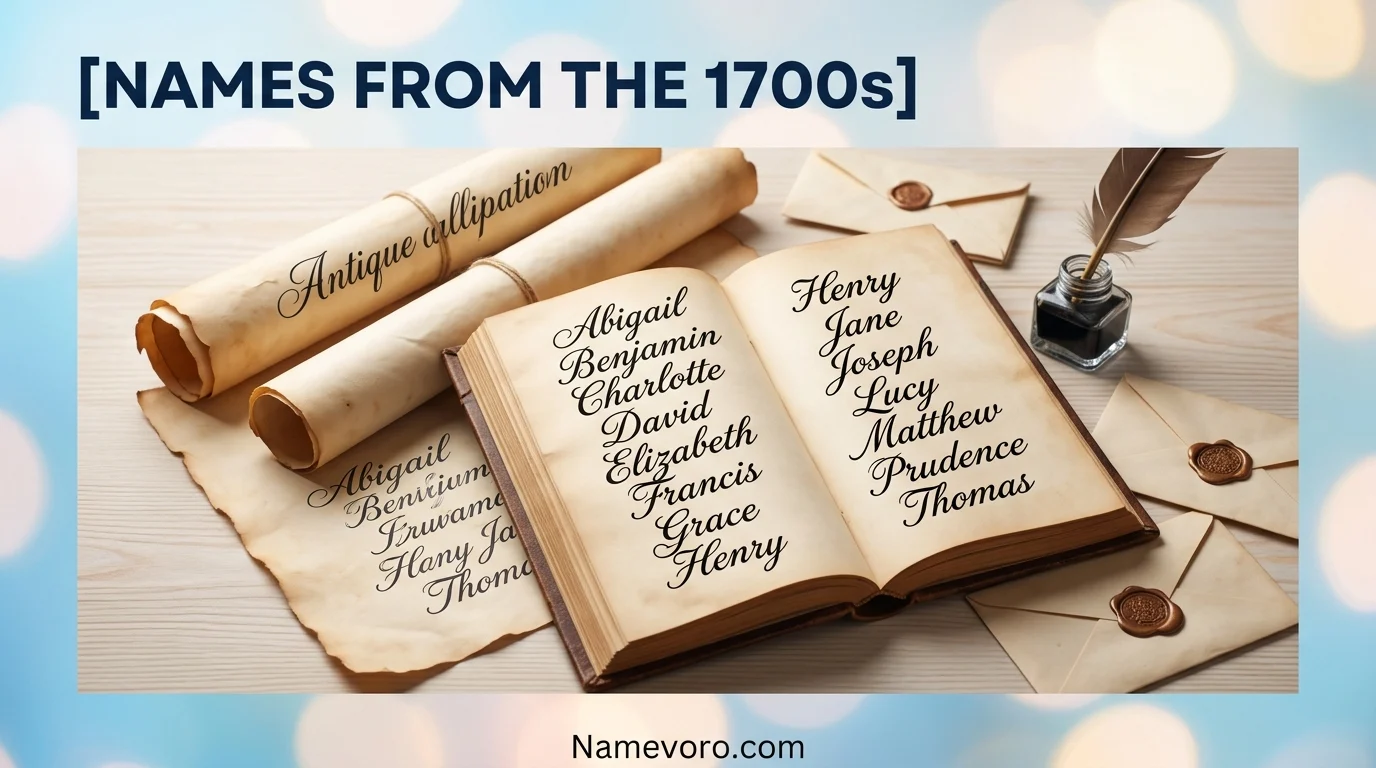
405+ Names from the 1700s (Timeless & Rare)
Names from the 1700s offer a fascinating glimpse into the lives, traditions, and cultures of people who lived more than two centuries ago. The 18th century was a period of major change, shaped by royal courts, religious traditions, colonial settlements, growing cities, and new ideas about society.
The names people chose for their children often reflected their family history, faith, social standing, or admiration for respected historical figures.
Today, these historical names appeal to parents searching for distinctive baby names, writers developing believable period characters, genealogy enthusiasts researching their ancestors, and anyone who loves vintage naming styles.
Familiar choices such as William, Elizabeth, James, Mary, and Thomas have endured for generations, while names such as Prudence, Ebenezer, Phineas, and Dorothea offer a more unusual connection to the past.
The best names from the 1700s are not simply old-fashioned. They carry stories about language, heritage, and changing cultural values. Some feel remarkably modern, while others preserve the unmistakable character of another era.
This guide explores popular historical names, distinctive choices for boys and girls, naming traditions, and practical ways to select an 18th-century name that feels meaningful today.
What Were Names From the 1700s Like?
Names from the 1700s were shaped by geography, religion, family traditions, and social customs. There was no single naming style across the world. A family in Georgian England might favor names associated with royalty or the Bible, while a family in colonial America might follow English traditions, regional customs, or the naming practices of its own cultural community.
In many European Christian communities, biblical names such as John, Mary, Elizabeth, and Joseph were common choices. Parents also named children after grandparents, godparents, monarchs, respected religious figures, and other relatives. Repeating a family name helped preserve a connection between generations.
Spelling was less standardized than it is today. Historical records may contain different spellings of the same name, sometimes even for the same individual. Literacy levels, local pronunciation, and the habits of the person recording a birth or baptism could influence how a name appeared in documents.
Another important distinction is that a name’s historical use does not automatically make it exclusive to the 18th century. Many names associated with the 1700s had already been used for centuries and remain popular today.
For historical accuracy, it is also important to distinguish a name’s origin from its popularity in a particular period. A name might have originated in ancient Greece, entered English through French, and become familiar in Britain during the 1700s. Its history can span several cultures and centuries.
Best Popular Boys’ Names From the 1700s
These traditional names were familiar in various English-speaking communities during the 18th century, although their popularity differed by region.
1. William
William was well established in Britain long before the 1700s and remained a familiar choice during the century. Its Germanic roots are associated with the ideas of will and protection. It suits a historical character who needs a classic, dignified name.
2. James
James has a long history in English and Scottish naming traditions. Related to Jacob, it is traditionally interpreted as connected with the Hebrew name Ya’aqov. Its familiarity makes it a strong choice for a historical protagonist or a modern baby name.
3. Thomas
Thomas comes from an Aramaic word meaning “twin.” Its use was strengthened by Christian tradition, particularly the association with Thomas the Apostle. The name feels grounded, traditional, and believable in an 18th-century setting.
4. John
John was widely established in English-speaking Christian communities. Derived through Hebrew and Greek forms, it is commonly understood to mean “God is gracious.” Its long history makes it suitable for almost any social setting in historical fiction.
5. George
George comes from the Greek Georgios, meaning “farmer” or “earthworker.” Its royal associations in Britain became particularly visible during the Hanoverian period, which began in 1714. It conveys a distinctly Georgian-era atmosphere.
6. Charles
Charles was associated with European royal families and established aristocratic traditions. Its deeper Germanic origins are commonly linked with the meaning “free man.” The name works especially well for characters from noble, political, or prosperous families.
Other traditional boys’ names worth considering include:
- Joseph — a biblical name traditionally interpreted as “he will add.”
- Samuel — a Hebrew name commonly interpreted as “God has heard.”
- Benjamin — traditionally understood as “son of the right hand.”
- Edward — an Old English name associated with wealth and guardianship.
- Henry — a Germanic name associated with household leadership.
- Richard — a Germanic name associated with strength and leadership.
- Robert — a Germanic name meaning “bright fame.”
- Daniel — a Hebrew name meaning “God is my judge.”
- Francis — a traditional European name associated with the meaning “Frenchman.”
- Nathaniel — a biblical name meaning “God has given.”
These names are useful starting points for historical research, but a realistic character’s name should also reflect the character’s location, family background, and approximate birth year.
Best Girls’ Names
Girls’ names in the 18th century frequently reflected Christian traditions, family connections, and established European naming customs. Names that remain familiar today often appeared alongside longer or more elaborate forms that sound distinctly historical to modern ears.
1. Elizabeth
Elizabeth has Hebrew origins and is traditionally interpreted as “my God is an oath” or “God is my oath.” It was familiar across English-speaking communities and associated with royalty, literature, and religious history. Its flexibility also makes it suitable for formal and informal characters.
2. Mary
Mary was deeply established in Christian naming traditions. Its ultimate etymology is debated, with several proposed interpretations. It is an excellent choice for a character whose family follows traditional religious naming practices.
3. Anne
Anne is related to Hannah, a Hebrew name commonly associated with grace or favor. Its short, elegant form was suitable for both ordinary and aristocratic families. The spelling Ann was also used.
4. Margaret
Margaret comes from a Greek word meaning “pearl.” It has a long European history and offers several familiar forms, including Peggy and Meg. This makes it useful for portraying a character whose formal name differs from what her family calls her.
5. Catherine
Catherine, also spelled Katherine, has been used throughout European history. Its deeper origin is debated, although it became associated with the Greek word katharos, meaning “pure.” It carries a formal, enduring character.
6. Sarah
Sarah is a Hebrew name meaning “princess” or “noblewoman.” Its biblical associations made it familiar in many Christian communities. It is a particularly useful option for a historical name that remains easy to pronounce and spell today.
Most Popular girl Names of the 1700s
More girls’ names with strong historical associations include:
- Jane — a feminine form related to John, traditionally meaning “God is gracious.”
- Charlotte — the feminine form of Charles.
- Rebecca — a biblical name whose precise meaning is uncertain.
- Hannah — a Hebrew name associated with grace or favor.
- Martha — an Aramaic name traditionally interpreted as “lady” or “mistress.”
- Dorothy — derived from Greek elements meaning “gift of God.”
- Susannah — a form of Susanna, associated with the lily.
- Lucy — derived from the Latin lux, meaning “light.”
- Frances — the feminine form of Francis.
- Abigail — a Hebrew name commonly interpreted as “my father is joy.”
When choosing a name for a historical character, remember that the same name could be common in one country and uncommon in another. A name list is a starting point, not proof that a particular name was widespread in every 18th-century community.
Best and Unique Uncommon Names
Some people prefer historical names that feel less familiar than William, James, Elizabeth, or Mary. Uncommon choices can give a character or baby a distinctive identity while retaining a connection to older naming traditions.
However, a name that sounds unusual today was not necessarily rare in the 1700s. Some names became less fashionable over time, while others remained common in particular religious communities or regions.
Here are some distinctive options.
| Name | Traditionally associated meaning or background | Best suited for |
|---|---|---|
| Ebenezer | Hebrew; “stone of help” | A solemn or religious character |
| Phineas | Hebrew name of biblical origin; precise etymology debated | A scholarly or distinctive character |
| Bartholomew | Aramaic patronymic meaning “son of Talmai” | A formal historical character |
| Hezekiah | Hebrew; “God strengthens” | A biblical or Puritan-inspired setting |
| Ephraim | Hebrew; associated with fruitfulness | A traditional religious family |
| Josiah | Hebrew; commonly interpreted as “God supports” | A thoughtful, serious character |
| Prudence | English virtue name | A restrained or devout character |
| Patience | English virtue name | A character from a religious household |
| Temperance | English virtue name | A period setting with strong moral themes |
| Dorothea | Greek; “gift of God” | A formal, elegant female character |
| Millicent | Germanic origin; associated with strength in work | A medieval-inspired or Georgian character |
| Lavinia | Ancient Roman name with uncertain etymology | A literary or aristocratic character |
Virtue names such as Prudence, Patience, and Temperance are especially associated with English-speaking religious traditions, including some Puritan communities. They can create a convincing historical impression, but they should be matched to a character’s cultural and religious background rather than used as generic labels for everyone who lived in the 1700s.
Puritan and Religious Roots of 18th-Century Names
Likewise, Ebenezer and Hezekiah may evoke biblical or strongly religious naming traditions. They are useful choices for period fiction, but an author’s setting should determine whether such names are appropriate.
For baby names, the best unusual choice is one that feels distinctive without becoming difficult to pronounce or explain. Dorothea, Josiah, and Millicent may offer a useful balance between historical character and modern usability.
Names from Colonial America
Colonial America did not have one uniform naming tradition. European settlers brought names from England, Scotland, Ireland, Germany, the Netherlands, and other parts of Europe. Indigenous nations maintained their own languages and naming customs, while enslaved Africans and their descendants experienced naming practices shaped by African heritage, family traditions, forced displacement, and colonial power.
This diversity matters when selecting names for historical writing or family research. A list of English names may be appropriate for an English-speaking colonial household but cannot represent the full population of 18th-century America.
In English-speaking colonial communities, familiar choices included names such as John, William, James, Thomas, Mary, Elizabeth, Sarah, and Anne. Biblical names were particularly relevant in many Protestant communities.
Some families used naming patterns that repeated a father’s, mother’s, or grandparent’s name. Others used surnames as given names, especially where family connections or local traditions supported that practice.
Classic Girl Names from the Colonial Era
Examples that can fit certain colonial settings include:
- Nathaniel — associated with biblical naming traditions.
- Josiah — a biblical name with a traditional religious feel.
- Abigail — a familiar biblical choice.
- Mercy — an English virtue name found in some historical naming traditions.
- Increase — a distinctive virtue-style name associated with some Puritan families.
- Experience — another historical virtuename.
- Benjamin — a biblical name used across several generations.
- Martha — a traditional biblical choice.
- Samuel — a long-established biblical name.
- Rebecca — a familiar name in English-speaking religious communities.
The most convincing historical name depends on the person’s community, language, faith, social position, and birth period. A name suitable for a New England Puritan family might not be suitable for a Spanish-speaking settlement, a French-speaking household, an Indigenous community, or an enslaved person’s historical record.
If you are researching an actual ancestor, prioritize census records, church registers, wills, and local historical documents over generalized lists. Records can reveal the spellings, naming patterns, and family relationships specific to a place.
Georgian-Era Names and Royal Influence
The Georgian era in Britain is conventionally associated with the reigns of George I through George IV, spanning 1714 to 1830. Because the 1700s fall largely within this period, Georgian names are often closely associated with 18th-century style.
Royal names could influence naming choices, especially among families who admired the monarchy or wanted to signal a connection to established traditions. George became particularly visible in Britain during this period, while names such as Charlotte, Caroline, Frederick, and Augusta were associated with royal and aristocratic circles.
That does not mean every family copied royal naming habits. Rural communities, religious groups, immigrant households, and working families could follow different patterns. A royal name might also have been used for generations before a particular monarch came to the throne.
Common Historical Meanings Behind These Names
For a Georgian-inspired character, consider these combinations:
| Masculine names | Feminine names |
|---|---|
| George William | Charlotte Anne |
| Charles Edward | Caroline Elizabeth |
| Frederick James | Augusta Mary |
| Henry Thomas | Sophia Charlotte |
| Arthur John | Frances Catherine |
| Edward Richard | Louisa Jane |
These are illustrative combinations rather than verified rankings of the most common full names of the century.
To make a character believable, consider how the name sounds alongside a surname, whether the family uses formal or familiar names, and how other characters address the person. A gentleman might be called Charles in a formal introduction and Charlie by a close family member, depending on the period and household. The same person can have several names in everyday use without changing the name recorded at birth.
Old-Fashioned Names With Beautiful Meanings
A name’s meaning can make a historical choice more personal. Some people prefer names with religious significance, while others favor meanings connected with nature, strength, wisdom, or light.
It is worth distinguishing a well-supported traditional meaning from a popular interpretation that may not reflect the name’s true linguistic origin.
Here are some options with commonly accepted meanings.
| Name | Meaning | Style |
|---|---|---|
| Clara | Bright or clear | Elegant and simple |
| Lucy | Light | Warm and classic |
| Felix | Happy or fortunate | Distinctive and upbeat |
| Grace | Grace or favor | Traditional and gentle |
| Hope | Hope | Virtue name |
| Faith | Faith or trust | Religious and timeless |
| Victor | Conqueror | Strong and formal |
| Florence | Flourishing or prosperous | Vintage and refined |
| Irene | Peace | Calm and traditional |
| Alexander | Defender of men | Classical and dignified |
| Theodore | Gift of God | Literary and traditional |
| Frederick | Peaceful ruler | Formal and historical |
These meanings reflect linguistic origins, not necessarily what every person in the 1700s believed a name represented.
For instance, a parent choosing Grace might have been drawn to its Christian significance, while another might simply have liked its sound. The name Theodore may evoke Greek history, biblical interpretation, or an old-fashioned family tradition, depending on the person using it.
When selecting a name based on meaning, investigate its original language, historical spelling, and cultural use. This is particularly important for names borrowed between languages, because pronunciation and meaning can change over time.
How to Choose an Authentic Name From the 1700s
A historically suitable name should make sense within the world in which the person lived. Whether you are naming a baby, creating a fictional character, or exploring a family tree, a few practical checks can help.
1. Start with the location
Identify the country, region, and community. Britain, colonial America, France, Spain, and German-speaking territories did not share identical naming traditions. Even neighboring communities could have different preferences.
2. Consider the birth year
A name used in 1705 may have a different cultural association from one that became fashionable later in the century. Royal events, migration, religious movements, and literature could influence naming choices over time.
3. Match the name to cultural background
Do not assume that all people in the 1700s had English or biblical names. Use culturally appropriate sources and consider the person’s language, religion, family traditions, and historical circumstances.
4. Research spelling and nicknames
Historical records may show multiple spellings of a name. Common forms can also differ from the formal name. For example, Peggy has historically been used as a nickname for Margaret, while Betsy and Bess have been used for Elizabeth.
Nicknames should still be checked against the particular period and region if historical precision matters.
5. Check the surname
A first name can sound appropriate by itself but feel out of place with a surname. For fiction, check whether the surname matches the character’s cultural background and social context. For a baby, consider pronunciation, initials, and how the full name will sound in daily life.
6. Balance historical accuracy with modern practicality
If you are naming a baby, you may want an old-fashioned name that is still easy to use today. Clara, Henry, Theodore, Lucy, and Charlotte offer a traditional feel without requiring most people to learn an unfamiliar spelling.
For a novel or historical game, a less familiar name may be more suitable if it fits the character’s background. The right choice depends on the purpose of the name, not simply how old it sounds.
Why Names From the 1700s Still Appeal Today
Historical names offer something different from names created mainly around recent trends: a long cultural history and a sense of continuity. A name such as Elizabeth or William can connect a child or fictional character to generations of people who used it before.
Many historical names are also adaptable. Elizabeth has nicknames such as Liz, Lizzie, Beth, and Bess. William can become Will, Billy, or Liam in some modern naming contexts. Margaret can become Maggie, Meg, or Peggy. These variations allow a formal name to feel personal.
Another attraction is the variety of styles available. Someone who prefers traditional names might choose Thomas or Mary. A person seeking a literary atmosphere might prefer Dorothea or Theodore. Someone interested in early American religious traditions might consider Josiah or Prudence.
Historical names also help writers establish a setting without lengthy explanations. A carefully chosen name can suggest a particular language, social background, or family tradition. However, a name alone cannot establish historical accuracy. Clothing, speech, geography, occupations, and cultural details must also fit the period.
For parents, the appeal is often more personal. A name may honor an ancestor, preserve a family tradition, or reflect an interest in history. That connection can give a name meaning beyond fashion.
FAQs:
What were the most common names in the 1700s?
Names such as John, William, James, Thomas, Mary, Elizabeth, Anne, and Sarah were established choices in many English-speaking communities during the 18th century. Biblical traditions and family naming customs helped maintain their use.
However, there was no single worldwide list of popular names for the 1700s. Exact rankings depend on the country, region, religious community, and historical records being studied.
What are some rare names from the 1700s?
Distinctive historical options include Ebenezer, Phineas, Hezekiah, Ephraim, Prudence, Patience, Temperance, Dorothea, and Millicent.
Some of these names were used in particular religious or regional communities and may not have been rare at the time. If historical accuracy is important, check whether the name appears in records from the relevant place and decade.
What were popular girls’ names in the 1700s?
Elizabeth, Mary, Anne, Margaret, Catherine, Sarah, Jane, Hannah, Martha, and Rebecca are useful examples of traditional girls’ names associated with English-speaking communities during the 18th century.
Their popularity varied by location and family background. Names used in Britain, colonial America, and other parts of Europe could differ significantly, so local evidence is valuable.
What were popular boys’ names in the 1700s?
William, John, James, Thomas, George, Charles, Joseph, Samuel, Benjamin, and Henry are strong starting points for exploring traditional boys’ names from the period.
These names have long histories and were not limited to the 1700s. For a particular character or ancestor, consider the person’s location, religion, language, and approximate birth year.
What are good 1700s names for historical fiction?
For a male character, consider William, Thomas, George, Nathaniel, Josiah, or Ebenezer. For a female character, consider Elizabeth, Anne, Charlotte, Dorothea, Prudence, or Abigail.
Choose names according to the character’s setting and background. A name that suits an English aristocratic family may not fit a rural Scottish household or a French-speaking community. Historical records from the relevant region can help you make a more convincing choice.
Are names from the 1700s suitable for modern babies?
Yes. Many historical names remain practical choices for modern children. Charlotte, Henry, Lucy, Theodore, Clara, William, and Elizabeth combine traditional roots with familiar spelling and pronunciation.
If you prefer something less common, Dorothea, Millicent, Josiah, or Phineas may be worth considering. Think about pronunciation, nicknames, family significance, and how the name might feel as the child grows older.
How can I find the name of an ancestor who lived in the 1700s?
Start with birth or baptism registers, marriage records, wills, church documents, cemetery records, and other local archives. Search for spelling variations because historical names were not always recorded consistently.
Cross-check multiple documents whenever possible. A baptism record, marriage entry, and will may refer to the same person in different ways, so names should be interpreted alongside dates, locations, family relationships, and other identifying details.
Conclusion:
Names from the 1700s preserve a rich record of family traditions, religious beliefs, language, and cultural change. From familiar choices such as William, Elizabeth, James, and Mary to distinctive names such as Dorothea, Phineas, Prudence, and Ebenezer, the 18th century offers options for many different tastes.
The most meaningful choice depends on what you want the name to express. Historical writers should consider the character’s location and background, genealogy researchers should rely on original records, and parents can balance vintage charm with modern usability.
Explore the names that interest you, investigate their origins, and pay attention to the stories behind them. A name with centuries of history can still feel personal, distinctive, and relevant today.

I am Fabian Lee, the passionate creator behind Namevoro. Dedicated to simplifying name choices and historical insights, I craft clear, concise, and compelling content that empowers readers to discover meaningful names effortlessly, ensuring a trusted and engaging experience for every visitor.




One Comment