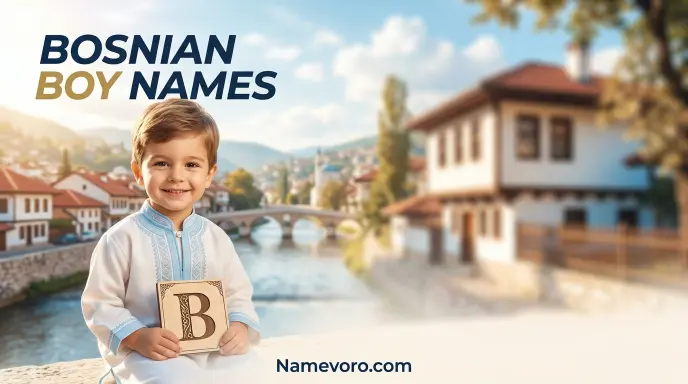
415+ Bosnian Boy Names: Meanings, Origins & Traditions
Choosing a name for your baby boy is a meaningful decision, especially when you want to honor Bosnian heritage, family traditions, or the cultural history of the Balkans. Bosnian boy names include a rich variety of traditional Muslim names, Slavic names, names shared across Balkan communities, and modern international choices that have become familiar in Bosnia and Herzegovina.
Many Bosnian families choose names such as Emir, Amar, Adnan, Haris, and Tarik because they sound natural in the region and carry associations with leadership, affection, history, or religious tradition. Others prefer names such as Luka, Marko, Nikola, and Vedad, depending on their family background, personal taste, and cultural connections.
One important distinction is that a name popular in Bosnia is not necessarily of Bosnian linguistic origin. Some names come from Arabic, Persian, Turkish, Hebrew, Greek, or Slavic languages and have become part of Bosnian naming culture over generations.
This guide explores traditional and modern Bosnian boy names, their commonly accepted meanings, pronunciation, cultural context, and practical considerations. Whether you want a distinctly traditional name, a meaningful Islamic name, or a short and contemporary choice, you will find options to help you make a thoughtful decision.
What Makes a Name Bosnian?
A Bosnian boy name is generally a name used within the Bosnian community, particularly in Bosnia and Herzegovina and among Bosnian families living abroad. Its cultural identity may come from centuries of local use rather than from the language in which the name first developed.
Bosnia and Herzegovina has a diverse cultural and religious history. Bosniaks, who are predominantly Muslim, commonly use names associated with Islamic traditions, while Bosnian Croats and Bosnian Serbs often use names connected to Catholic and Orthodox Christian traditions, respectively. Individual families may also follow different personal, regional, and family naming customs.
This diversity makes Bosnian naming traditions especially interesting. A name such as Amar may appeal to parents seeking a short name familiar in Bosniak communities, while Luka or Marko may appeal to families drawn to South Slavic and Christian naming traditions.
Three broad categories can help you explore the possibilities:
- Traditional Bosnian names: Names established through long-standing family and community use.
- Islamic names popular in Bosnia: Names with Arabic, Persian, Turkish, or other linguistic roots that are familiar in Bosniak communities.
- Slavic and contemporary names: Names associated with the wider Balkan region, including traditional Christian names and modern choices.
The categories overlap. A name can be widely used in Bosnia without originating in the Bosnian language, and the same name may be popular in several neighboring countries.
Popular Bosnian Boy Names and Their Meanings
Meanings below reflect common name interpretations. Some names have multiple proposed origins or meanings, so verify an individual name’s etymology before making a final choice.
These names are a useful starting point for parents looking for something familiar, culturally relevant, and easy to use in everyday life.
| NameCommonly given meaning or associationNaming style | ||
|---|---|---|
| Emir | Commander, prince, or leader | Traditional Islamic |
| Amar | Often associated with long life or flourishing; interpretations vary | Modern Bosniak |
| Adnan | A traditional Arabic name associated with an ancestral name | Islamic |
| Haris | Guardian or protector in common Arabic-derived interpretations | Islamic |
| Tarik | Morning star or one who comes at night, depending on interpretation | Islamic |
| Faris | Knight or horseman | Arabic-derived |
| Hamza | Traditional Arabic name; associated historically with strength and courage | Islamic |
| Ahmed | Highly praised | Islamic |
| Ali | High, elevated, or noble | Islamic |
| Kenan | A traditional name with several proposed origins and interpretations | Regional |
| Armin | A name used across Central Europe and the Balkans; origin and meaning are debated | Regional |
| Amar | A popular modern choice in parts of the Balkans | Contemporary |
| Mirza | A historical title and personal name associated with Persianate traditions | Traditional |
| Vedad | Commonly associated with affection or love in Bosnian name interpretations | Bosniak |
| Nermin | A name of Persian or Turkish transmission, often interpreted as gentle or soft | Regional |
| Samir | Companion in evening conversation in Arabic-derived usage | Islamic |
| Jasmin | Derived from jasmine, the flowering plant | Regional |
| Denis | A European name derived from Dionysius | Contemporary |
| Adis | A familiar name in Bosnia; its exact etymology is not universally established | Regional |
| Alen | A regional form of Alan or a related name, with debated origins | Contemporary |
How should you choose among these names? Start with the qualities you want the name to convey. Emir may appeal to parents who like the association with leadership. Faris may suit a family drawn to historical and courageous imagery. Jasmin offers a connection to nature, while Vedad is attractive to parents who value interpretations connected with affection.
Do not assume that every name has one universally accepted meaning. Popular baby-name websites sometimes repeat simplified explanations without distinguishing an original linguistic meaning from a later cultural interpretation. If a specific meaning matters to your family, check the name’s original language, spelling, and historical usage.
Traditional Bosnian Boy Names
Traditional names often carry a connection to grandparents, local history, religious practice, and family identity. In Bosnia and Herzegovina, tradition does not mean the same thing to every household. A name considered traditional in a Bosniak Muslim family may differ from one associated with a Bosnian Croat or Bosnian Serb family.
For Bosniak families, names such as Mehmed, Mustafa, Ibrahim, Ismail, Sulejman, Hasan, Husein, and Osman have longstanding associations with Islamic naming traditions. Many have Arabic origins and entered local use through the region’s religious and historical connections with the Ottoman Empire.
Other names, including Zlatan, Zoran, Dragan, Milan, and Goran, reflect Slavic naming traditions found in Bosnia and across the wider Balkans. These names can carry associations with qualities such as gold, dawn, preciousness, or mountains, although the exact linguistic history varies by name.
Here are additional traditional choices to explore:
- Abdulah: A form of Abdullah, commonly understood as servant of God.
- Avdo: A familiar regional form associated with Abdullah in some naming traditions.
- Bekir: A form of Bakr, a name with a long history in Arabic-speaking and Muslim communities.
- Dževad: A Bosnian form of a name associated with generosity or nobility in Arabic-derived interpretations.
- Enver: A name commonly associated with brightness or radiance.
- Fadil: Associated with virtue, merit, or excellence in Arabic-derived usage.
- Fehim: Commonly associated with understanding or intelligence.
- Hamdija: A traditional regional form connected with names derived from Arabic hamd, meaning praise.
- Meho: A familiar Bosnian nickname or shortened form associated with Mehmed.
- Šaban: A traditional name transmitted through Arabic and Ottoman naming traditions.
- Safet: A Bosnian form associated with names such as Safwat, though exact interpretations can vary.
- Salih: Commonly understood as righteous or virtuous.
- Vehid: Associated with uniqueness or oneness in Arabic-derived usage.
- Zijad: A Bosnian form associated with names derived from Arabic ziyāda, meaning increase or abundance.
Traditional names can be especially meaningful when a child is named after a respected relative. However, parents do not need to choose a name solely because it appears in their family tree. A thoughtful compromise is to honor a grandparent through a middle name while selecting a first name that feels comfortable in modern life.
One practical consideration is the difference between a formal name and its everyday form. A family may officially name a child Mehmed but affectionately call him Meho. Before choosing a traditional name, consider whether you like both its full form and the nicknames likely to develop naturally.
Islamic Bosnian Boy Names
Islamic names are an important part of naming traditions among Bosniak Muslims. Many are associated with prophets, respected historical figures, virtues, or words used in Arabic-speaking Muslim communities. Their presence in Bosnia reflects religious continuity as well as centuries of cultural exchange.
Parents choosing an Islamic Bosnian boy name often consider three questions: Does the name have a meaningful interpretation? Is it connected with a respected religious figure? And does it sound natural with the family’s surname?
The following names are widely recognized in Muslim naming traditions and may also be familiar to Bosnian families.
| Name | Common meaning or association |
|---|---|
| Adem | Bosnian form of Adam, the first human in Islamic and Abrahamic traditions |
| Ahmed | Highly praised |
| Ali | High or exalted |
| Ammar | Commonly interpreted as one who builds, maintains, or flourishes |
| Bilal | A historically significant early Muslim name |
| Davud | Bosnian form of David, a prophet in Islam |
| Harun | Bosnian form of Aaron, a prophet in Islam |
| Hasan | Good, handsome, or excellent in Arabic-derived usage |
| Husein | Bosnian form of Husayn, a significant name in Islamic history |
| Ibrahim | Abraham, a major prophet in Islam |
| Ismail | Ishmael, a prophet in Islam |
| Jusuf | Bosnian form of Joseph, a prophet in Islam |
| Muhamed | Bosnian form of Muhammad, commonly understood as praised |
| Musa | Moses, a major prophet in Islam |
| Nuh | Noah, a prophet in Islam |
| Omer | Bosnian form associated with Umar, a major early Islamic historical figure |
| Salih | Righteous or virtuous |
| Sulejman | Bosnian form of Solomon, a prophet in Islam |
| Zekerija | Bosnian form of Zechariah, a prophet in Islam |
| Junus | Bosnian form of Jonah, a prophet in Islam |
A religiously significant name can offer a child a meaningful connection to family faith. For example, Ibrahim connects the child to a prophet revered in Islam, Christianity, and Judaism. Musa carries a similar cross-Abrahamic connection through Moses, while Bilal recalls an important figure in early Muslim history.
Still, the name alone does not determine a person’s character or spiritual life. Parents may view a meaningful name as an expression of hope, remembrance, and family values rather than as a guarantee of any particular outcome.
Spelling matters, too. Names can look different when written in Arabic, Latin, or other scripts. Bosnian spellings such as Muhamed, Jusuf, and Sulejman reflect established local usage. A different transliteration may also be valid in another language or community.
If you want a name with a specific religious connection, verify that connection using a reliable Islamic reference or a knowledgeable religious teacher rather than relying only on a baby-name meaning list.
Modern and Stylish Bosnian Boy Names
Modern Bosnian names appeal to parents who want a name that feels current without losing its connection to the region. Some have long histories but sound contemporary because they are short and internationally recognizable. Others have become popular through media, travel, and changing family preferences.
Consider these options:
- Amar: Short, familiar in Bosniak communities, and easy to pronounce in many languages.
- Armin: A regional favorite with an international feel.
- Dino: A familiar short form or given name used in Bosnia and elsewhere in Europe.
- Emin: A name commonly associated with trustworthiness or faithfulness in Arabic-derived usage.
- Eldar: A name used across several regions, with different proposed etymologies.
- Imran: A name associated with Islamic tradition and recognized in the Quran.
- Kerim: A Bosnian form related to Arabic Karim, meaning generous or noble.
- Malik: A name associated with king or ruler in Arabic, depending on pronunciation and derivation.
- Nedim: A name commonly associated with a companion or close friend in Arabic-derived usage.
- Rayan: A modern international spelling associated with the Arabic name Rayyan.
- Tarin: A contemporary-sounding choice whose origin and meaning should be verified.
- Vedad: Distinctive and familiar in Bosnian naming culture.
- Zejd: A Bosnian form related to Zayd, commonly associated with growth or increase.
Moderen Names
A modern name can be a good choice if it balances three things: personal appeal, cultural fit, and long-term usability. Imagine a child who will use the name at home, in school, in a professional setting, and possibly in another country. A name that works across those environments can make everyday introductions easier.
However, international pronunciation should not become the only deciding factor. A name does not need to sound English or be instantly familiar worldwide to be a good choice. Preserving Bosnian spelling or pronunciation may be more important to a family than simplifying it for others.
A useful test is to say the name aloud in several situations: when calling a child at home, introducing him formally, and pairing it with the family surname. If it feels natural in each context, it may be a strong contender.
Short Bosnian Boy Names
Short names can be memorable, easy to write, and practical across languages. They are particularly appealing to parents who prefer a simple first name or have a long family surname.
Here are short names to consider:
| Name | Meaning or background |
|---|---|
| Alen | A regional form of Alan or a related name |
| Amar | Popular in Bosniak naming culture; meanings vary by proposed origin |
| Arif | Knowledgeable or wise |
| Dino | A familiar name and short form in several European cultures |
| Emir | Commander or leader |
| Enes | A name with Arabic roots and established Bosnian use |
| Haris | Guardian or protector in common interpretations |
| Iman | Faith in Arabic-derived usage |
| Kenan | A name with several proposed origins |
| Leon | Lion, through Greek and Latin-derived naming traditions |
| Mirza | Historical title and personal name |
| Naim | Commonly associated with comfort, ease, or bliss |
| Niko | Short form used in several European naming traditions |
| Omar | International form associated with the Arabic name Umar |
| Vedad | A name associated with affection or love in Bosnian interpretations |
| Zaid | Growth or increase in Arabic-derived usage |
Short names are especially convenient when a family surname is long or contains sounds that are unfamiliar to people outside Bosnia. They can also work well for children growing up in multilingual households.
However, shorter does not always mean easier. A name such as Džan contains the Bosnian letter dž, which represents a sound similar to the English j in jam. A name such as Nuh may be written or pronounced differently by speakers of different languages. If your family lives abroad, consider whether you want to preserve the original spelling or use a recognized alternative for international documents.
Also consider how the name sounds with a middle name. A one-syllable or two-syllable first name can create a balanced full name, but rhythm depends on the surname, stress patterns, and the sounds at the boundaries between names.
Unique and Less Common Bosnian Boy Names
Some parents want a name that feels distinctive without sounding disconnected from their heritage. In this case, exploring less frequently encountered traditional names or regional spellings can be more rewarding than inventing an entirely new name.
The following names may be worth researching:
- Ajnur: A name used in Muslim communities; interpretations can differ by source.
- Alem: Used in several Muslim naming traditions, with different proposed meanings and origins.
- Dženan: A Bosnian name often associated with the Persian-derived word for paradise gardens in popular interpretations.
- Erol: A name transmitted through Turkish naming traditions.
- Fikret: A traditional name associated with thought or reflection.
- Idriz: A Bosnian form of Idris, a prophet in Islamic tradition.
- Mahir: Commonly associated with skill or proficiency.
- Mevludin: A traditional name connected with the Arabic-derived mawlid naming tradition.
- Munib: Commonly interpreted as one who turns toward God or returns.
- Nihad: A name used in Bosnia and other communities, with interpretations that vary by origin.
- Refik: Associated with companionship or friendship in Arabic-derived usage.
- Rusmir: A regional name whose exact etymology should be checked rather than assumed.
- Senad: A familiar Bosnian name with historical regional usage.
- Šefik: A traditional name associated with kindness or compassion in common interpretations.
- Zaim: A name with historical title associations and established use in Muslim communities.
Uniqueness is relative. A name that seems unusual to an English-speaking parent may be entirely familiar in Sarajevo, Tuzla, Mostar, or another Balkan community. Conversely, a name widely used in one family or region may be unfamiliar elsewhere.
Different generation with names
If rarity is your priority, ask relatives from different generations which names they recognize. You can also review local birth-registration statistics if reliable data are available. Avoid assuming that a name is rare simply because it appears infrequently on English-language baby-name websites.
Another important consideration is spelling. Bosnian letters such as č, ć, dž, đ, š, and ž are meaningful parts of the language, not decorative variations. A distinctive spelling can preserve cultural identity, but parents should also consider the practical requirements of passports, airline bookings, school records, and international databases.
The best uncommon name is not necessarily the strangest one. It is one that feels meaningful to the family, can be pronounced comfortably in the child’s likely environments, and has an origin the parents understand.
Boy Names With Strong Meanings
Parents often look for names associated with strength, wisdom, kindness, courage, or leadership. These qualities can provide a personal theme for the naming decision, especially when a family hopes a name will reflect values they want to encourage in their child.
Here are options grouped by their commonly accepted associations.
Names associated with leadership and nobility
- Emir: Commander or leader.
- Malik: King or ruler in a common Arabic interpretation.
- Mirza: A historical title used as a personal name.
- Faris: Knight or horseman.
- Zaim: A name associated historically with leadership or authority.
Best Names associated with wisdom and virtue
- Arif: Knowledgeable or wise.
- Fadil: Virtuous, excellent, or possessing merit.
- Fehim: Understanding or intelligent.
- Salih: Righteous or virtuous.
- Emin: Trustworthy or faithful in common Arabic-derived interpretations.
Names associated with affection and friendship
- Vedad: Often associated with affection or love in Bosnian interpretations.
- Nedim: Companion or close friend in Arabic-derived usage.
- Samir: Companion in evening conversation.
- Refik: Companion or friend.
- Kerim: Generous or noble.
Famous Names associated with growth and flourishing
- Zaid: Growth or increase.
- Ammar: Commonly associated with building, maintaining, or flourishing.
- Naim: Associated with ease, comfort, or bliss.
- Rayyan: A name associated in Islamic tradition with a gate of Paradise for those who fast.
These associations can help narrow your shortlist, but a name’s meaning should not be treated as a prediction of personality. Naming a boy Emir does not guarantee leadership, just as choosing Salih does not guarantee righteousness. Rather, parents can use the name as a reminder of the qualities they hope to nurture through example, education, and family life.
For a more informed decision, distinguish between a dictionary translation, a historical association, and a modern symbolic interpretation. All three can be meaningful, but they are not interchangeable. If the name’s meaning is central to your choice, look for agreement between reliable linguistic references and sources familiar with the relevant cultural tradition.
Bosnian Boy Names From Slavic Traditions
Bosnian naming culture includes names with South Slavic roots, as well as names shared with neighboring Serbian, Croatian, Montenegrin, and other Balkan communities. These names can be particularly relevant for families seeking a connection to regional language and history rather than a specifically Arabic-derived or religious name.
Examples include:
| Name | Common meaning or association |
|---|---|
| Boran | A name used in the region and beyond; origins vary |
| Branko | A traditional South Slavic name |
| Dragan | Derived from a Slavic root associated with something dear or beloved |
| Goran | Associated with mountains or mountainous places |
| Milan | A Slavic name associated with graciousness or being dear |
| Miloš | A traditional Slavic name related to a root associated with kindness or affection |
| Nenad | A traditional South Slavic name with an established regional history |
| Nikola | A form of Nicholas, commonly interpreted as victory of the people |
| Predrag | A Slavic name associated with something very dear or beloved |
| Zoran | Connected with dawn in South Slavic naming tradition |
| Zlatan | Associated with gold or being golden |
| Željko | Derived from a Slavic root associated with desire or wish |
These names illustrate why it is inaccurate to treat all Bosnian names as a single religious or linguistic category. A name can be authentically part of Bosnian naming culture because families have used it across generations, even when its linguistic roots extend throughout the Slavic world.
The cultural meaning of a name can also change according to the family. For one household, Milan may be a way to honor a grandfather. For another, it may simply be a name they like. Both are valid reasons to choose it.
If you are selecting a name from a Slavic tradition, pay attention to diacritics. The difference between S and Š, or between C, Č, and Ć, can change pronunciation and sometimes distinguish one name from another. Confirm the spelling with a reliable Bosnian-language source before finalizing legal documents.
How to Choose the Right Bosnian Boy Name
A good name should work in the family’s real life, not merely look appealing on a list. The following process can help you move from dozens of possibilities to a confident final choice.
Step 1: Decide what matters most
Begin by identifying your main priority. You may want an Islamic name, a traditional Bosnian name, a name with a strong meaning, or a short name that works internationally. You can combine several priorities, but choosing one primary goal makes comparisons easier.
For example, if religious significance is essential, you might begin with Ibrahim, Musa, Ahmed, or Bilal. If you prefer a name associated with leadership, Emir may be a natural candidate.
Step 2: Verify the meaning and origin
Do not rely on a single baby-name website when the etymology is important to you. Check whether the name comes from Arabic, Persian, Turkish, Slavic, Greek, Hebrew, or another language, and distinguish the original meaning from the interpretation used in Bosnia.
This is particularly important for names that have crossed several languages. A spelling can be transmitted through Turkish or Bosnian usage while retaining an older origin elsewhere.
Step 3: Say the full name aloud
Combine the first name with the surname and any middle name. Listen for repeated sounds, awkward transitions, and the overall rhythm. Try saying it as if you were introducing the child at school or using the name in a formal setting.
A name that sounds beautiful alone may feel less natural when combined with a long surname. Conversely, a short name can provide balance to a longer family name.
Step 4: Consider pronunciation and spelling
If your family lives outside Bosnia, decide whether the original spelling is important to preserve. Bosnian diacritics are part of correct spelling, but some international forms and transliterations are also widely recognized.
Avoid changing a name solely because others may need to learn its pronunciation. At the same time, understand the practical requirements of local registration systems before settling on a spelling.
Step 5: Check family and religious preferences
If grandparents or other relatives are involved in the decision, ask which names have particular family significance. If religious meaning is central, consult an appropriate source for confirmation.
A useful compromise may be to use a traditional family name as a middle name and choose a first name that both parents particularly love.
Step 6: Test your shortlist
Reduce the list to three to five names and live with them for a few days. Write each one alongside the surname, say it aloud, and consider possible nicknames.
Ask yourself whether you would still like the name if it became more common, and whether you would still feel comfortable with it if other people interpreted its meaning differently. These questions can help separate a lasting preference from a temporary trend.
The goal is not to find a universally perfect name. It is to find one that fits your family’s language, heritage, values, and hopes for your child.
FAQs:
What are the most popular Bosnian boy names?
Names such as Emir, Amar, Adnan, Haris, Tarik, Ahmed, and Muhamed are familiar choices in Bosniak naming culture. Their popularity can vary by generation, location, and family background.
If you want a name that feels traditional but still works well internationally, consider Emir, Amar, or Adnan. For a name with a strong religious association, Ibrahim, Ahmed, and Musa are worth exploring.
What are some traditional Muslim Bosnian boy names?
Traditional choices include Mehmed, Mustafa, Ibrahim, Ismail, Hasan, Husein, Osman, Sulejman, and Muhamed. Many have Arabic roots and are used in Bosniak Muslim communities.
These names may appeal to parents who want to honor religious heritage or continue a family naming tradition. Before choosing one for its religious significance, confirm its meaning and historical associations through a reliable source.
What Bosnian boy names have beautiful meanings?
Names associated with positive qualities include Emir, meaning commander or leader; Arif, commonly associated with knowledge or wisdom; Salih, meaning righteous or virtuous; and Kerim, meaning generous or noble.
Vedad is often associated with affection or love in Bosnian name interpretations. Because meanings can differ by linguistic origin, verify the specific interpretation that matters to your family.
What are some unique Bosnian boy names?
Distinctive options to research include Dženan, Fikret, Nihad, Munib, Refik, Šefik, and Zijad. Some are traditional names that may feel uncommon to people outside the Balkans, even though they have established regional histories.
If uniqueness is important, check how frequently the name is used in the community where your child will grow up. A name’s rarity on international websites does not necessarily mean it is rare in Bosnia and Herzegovina.
Are Bosnian boy names mostly Islamic?
No. Bosnian naming traditions reflect the country’s diverse religious, linguistic, and cultural communities. Many Bosniak families use Islamic names, while Bosnian Croat and Bosnian Serb families often choose names associated with Catholic or Orthodox Christian traditions, respectively.
Names from South Slavic languages are also used across community boundaries. The best way to understand a name’s cultural background is to consider its linguistic origin, local history, and actual use rather than assuming that every Bosnian name belongs to one religious tradition.
What are some short Bosnian boy names that are easy to pronounce?
Amar, Emir, Alen, Dino, Niko, and Leon are options that many international audiences may find relatively straightforward to pronounce. However, familiarity depends on the languages spoken by the people around the child.
If you prefer a name with distinctively Bosnian spelling, options such as Džan or Nuh may also appeal to you. Decide whether preserving the original spelling or choosing an established international variant is more important for your circumstances.
How can I find the correct meaning of a Bosnian boy name?
Start by identifying the name’s likely original language. Many Bosnian names entered local use through Arabic, Persian, Turkish, Slavic, Greek, Hebrew, or other naming traditions, and their meanings may have changed or diversified along the way.
Compare reputable linguistic references with sources familiar with Bosnian cultural usage. For names connected to religious figures, consult an appropriate religious reference as well. This approach helps distinguish a well-supported etymology from a popular interpretation repeated on baby-name websites.
Conclusion:
Bosnian boy names offer a rich selection of traditional, religious, Slavic, and modern choices. Whether you are drawn to Emir for its association with leadership, Ibrahim for its religious significance, Vedad for its connection with affection, or Zoran for its Slavic heritage, the right name is one that feels meaningful to your family.
The most thoughtful approach is to look beyond popularity. Consider the name’s linguistic origin, cultural background, pronunciation, spelling, and connection to your family’s values. If religious significance matters, verify the historical or spiritual association instead of relying on an unconfirmed baby-name definition.
It is also worth saying the complete name aloud and considering how it will work in your child’s everyday life, from family introductions to school and professional settings.
Ultimately, a name is both a personal choice and a connection to a larger story. By exploring Bosnian naming traditions carefully, you can choose a name that honors your heritage, reflects your hopes, and gives your son a meaningful link to his family’s identity.
Final tip: Shortlist three to five names, verify their meanings, and discuss your favorites with your family before making your final decision.

I am Fabian Lee, the passionate creator behind Namevoro. Dedicated to simplifying name choices and historical insights, I craft clear, concise, and compelling content that empowers readers to discover meaningful names effortlessly, ensuring a trusted and engaging experience for every visitor.


2 Comments