
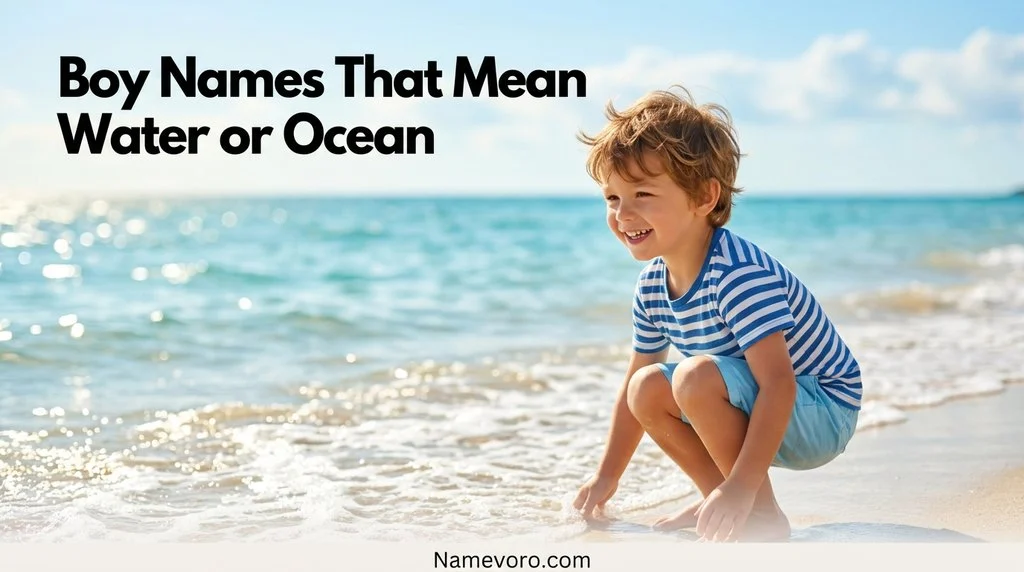
Choosing a baby boy’s name inspired by water can connect your child’s identity with strength, peace, freedom, and the natural world. From names associated with the vast ocean to those linked with rivers, rain, waves, and the sea, water-inspired names offer a remarkable range of meanings and personalities.
Some parents want a bold name that evokes the power of crashing waves. Others prefer a calm, gentle name that reflects flowing rivers, clear lakes, or the quiet beauty of the shore. Still others look for a meaningful name rooted in mythology, ancient languages, or cultural traditions.
This guide explores boy names that mean water or ocean, explains their origins and associations, and distinguishes names with direct water-related meanings from those inspired by aquatic symbolism. You’ll discover familiar favorites, uncommon gems, international choices, and practical tips for choosing a name that sounds natural with your family’s surname.
Whether you’re searching for a name that feels adventurous, timeless, spiritual, or refreshingly modern, the best choice is one whose meaning and sound resonate with you.
Quick Answer:
Some popular water-inspired boy names include Kai, commonly associated with the sea in Hawaiian; Morgan, traditionally interpreted as “sea-born” or “sea-circle” in Welsh name traditions; Dylan, associated with the sea in Welsh mythology; River, an English nature name; and Ocean, a direct English word name.
Other options include Murray, connected with Scottish place-name traditions, and Adrian, associated with the Adriatic region rather than directly meaning ocean.
The key distinction is that some names literally refer to water, while others derive their meaning from mythology, geography, or cultural associations.
Popular Boy Names That Mean Water or Ocean
These names are strong starting points if you want something recognizable, meaningful, and easy to imagine on a child and an adult. Their water connections range from direct word meanings to traditional interpretations and mythological stories.
| Name | Meaning or Water Connection | Origin |
|---|---|---|
| Kai | Sea in Hawaiian usage | Hawaiian |
| Dylan | Welsh mythological name associated with the sea | Welsh |
| River | A flowing natural waterway | English |
| Ocean | The vast body of salt water | English |
| Morgan | Traditionally associated with the sea | Welsh |
| Adrian | Associated with the Adriatic region | Latin |
| Murray | Scottish name connected with the Moray region | Scottish |
| Brooks | Small streams or brooks | English |
| Wade | Associated with crossing through water; also an established personal name | English |
| Ford | A shallow place where a river can be crossed | English |
Kai: A Short Name With a Strong Sea Connection
Kai is one of the most appealing choices for parents who want a short, modern-sounding name with a meaningful connection to the ocean. In Hawaiian, kai means “sea” or “ocean,” making it a particularly direct choice for families who love the Pacific and its coastal landscapes.
The name is easy to pronounce in English and contains only one syllable. It pairs naturally with longer middle names, such as Kai Alexander or Kai Benjamin, and works with many different surname lengths.
Kai also appears in other cultures, sometimes with different meanings or linguistic roots. It should not automatically be assigned the Hawaiian meaning in every cultural context. If the sea meaning is central to your decision, recognize the Hawaiian origin specifically.
Best for: Parents seeking a short, versatile boy’s name with a direct ocean connection.
Dylan: A Name Rooted in Welsh Sea Mythology
Dylan is a traditional Welsh name associated with the sea through Welsh mythology. In the Mabinogion, a collection of medieval Welsh tales, Dylan ail Don is a figure connected with the sea. The name is often interpreted in relation to the sea, although its precise linguistic meaning is more complex than a simple one-word translation.
Its appeal comes from its combination of cultural history and everyday familiarity. Dylan feels established without sounding formal, and it fits a child who may grow into any number of personalities or interests.
For parents who want a name with a story behind it rather than a literal nature word, Dylan offers a compelling balance. It is also an option for families interested in Welsh heritage or Celtic mythology.
Best for: Parents who want a familiar name with a meaningful connection to sea mythology.
River: A Peaceful Nature Name
River is an English word name that refers directly to a natural waterway. Unlike names whose water meanings depend on ancient etymology, River makes its association immediately clear.
A river can symbolize movement, renewal, persistence, and change. It follows a path while adapting to the landscape around it, making it a thoughtful metaphor for a child growing into his own identity.
River has a relaxed, contemporary sound and is used as a given name for boys and girls. If you’re choosing it for a boy, it pairs well with traditional middle names such as River James or River Thomas.
Its nature-inspired style is especially suitable for families who appreciate hiking, forests, camping, fishing, or spending time outdoors.
Best for: Parents who prefer a modern, nature-centered name with an unmistakable water meaning.
Ocean: A Bold and Unmistakable Choice
Ocean is a direct English word name referring to the enormous bodies of salt water that cover most of Earth’s surface. It evokes depth, scale, mystery, and freedom.
As a given name, Ocean is more unconventional than Kai or Dylan. That distinction can be an advantage if you want your child’s name to stand out, although it is worth considering whether you prefer a distinctive word name or a traditional personal name.
Ocean may pair best with a relatively simple middle name, such as Ocean James or Ocean Michael. The familiar middle name creates a balance with the more unusual first name.
Because Ocean is a nature word rather than an ancient personal name with a long established naming tradition, its appeal comes primarily from imagery and symbolism.
Best for: Parents who want a striking, contemporary name that directly represents the sea.
Rare and Uncommon Boy Names Inspired by Water
If you want a less familiar name, consider choices rooted in mythology, regional languages, and historic place names. These can offer a deeper sense of discovery than simply choosing an English word for a body of water.
The names below have different levels of connection to water. Some are associated with sea gods or water spirits, while others are linked to rivers, lakes, or coastal geography.
| Name | Meaning or Association | Origin |
|---|---|---|
| Nereus | Ancient Greek sea deity | Greek mythology |
| Varuna | Vedic deity associated with cosmic order and waters | Sanskrit tradition |
| Aalto | “Wave” in Finnish | Finnish |
| Oceanus | Personification of the great ocean in Greek mythology | Greek mythology |
| Llyr | Welsh mythological figure associated with the sea | Welsh mythology |
| Nahuel | Commonly interpreted as “jaguar,” not water | Mapuche |
| Deniz | “Sea” | Turkish |
| Marinus | “Of the sea” | Latin |
| Talay | “Sea” | Thai |
| Caspian | Inspired by the Caspian Sea | Geographic name |
Nereus: An Ancient Name of the Sea
Nereus comes from Greek mythology, where he is an ancient sea deity associated with the sea’s wisdom and gentler aspects. He is often described as a truthful and prophetic figure who can change shape.
The name is uncommon in modern English-speaking communities, making it a distinctive option for parents drawn to classical mythology. It also has a more traditional personal-name structure than Ocean, which may appeal to families who want something unusual without choosing a direct English noun.
Nereus is generally pronounced approximately NEER-ee-us, although pronunciation may vary. Parents should be comfortable explaining the spelling and pronunciation if they choose it.
The name is best understood as mythologically sea-associated, not as a straightforward translation of the word “ocean.”
Best for: Families who appreciate Greek mythology and want a rare name with an ancient sea connection.
Varuna: A Name With Deep Water Traditions
Best Varuna is a Sanskrit name associated with a major deity in Vedic tradition. Varuna is connected with cosmic order, moral law, and the waters, making the name significant beyond a simple nature reference.
For families with South Asian cultural or spiritual connections, Varuna may feel especially meaningful because its associations arise from a living religious and literary heritage. Its appeal is not limited to the image of the ocean; it also evokes order, responsibility, and the relationship between human life and the natural world.
Because Varuna comes from a specific cultural and religious context, parents should understand that background rather than treating it as a generic exotic-sounding name. Pronunciation is commonly approximated as VUH-roo-nuh, with variations depending on language and accent.
Best for: Parents who value Sanskrit names and want a water-related choice with cultural and spiritual depth.
Aalto: A Name That Means “Wave”
Aalto is a Finnish surname and word associated with the meaning “wave.” It offers a subtle alternative to more familiar sea-inspired names.
Its appeal is visual as well as symbolic: a wave suggests energy, movement, and the continuous rhythm of water. Aalto feels distinctive and compact, though English-speaking families may need to explain its pronunciation and Finnish background.
Aalto is more familiar as a surname than as a conventional first name in many places. Before choosing it, consider whether you want a name with an established given-name tradition or are comfortable adapting a surname or word into a first name.
Best for: Parents seeking a rare, minimalist choice inspired by waves and Nordic language.
Deniz: A Direct Sea Meaning
Deniz is a Turkish name that means “sea” and is used as a given name for different genders. For a boy, it offers a clear connection to water without using an English word name.
The name has a clean, two-syllable sound and an established cultural context. It may be particularly attractive to families with Turkish heritage or those who want an internationally recognizable nature meaning.
Pronunciation is generally close to deh-NEEZ in Turkish, although English speakers may initially pronounce it differently. If accurate pronunciation matters to you, learn the Turkish pronunciation before settling on the name.
Best for: Parents seeking a culturally rooted name with a direct meaning of “sea.”
Marinus: “Of the Sea”
Marinus is derived from Latin marinus, meaning “of the sea” or “marine.” It belongs to the same broad family of sea-related vocabulary that includes words such as marine.
Compared with Ocean, Marinus feels more classical and formal. It may appeal to parents who like historical names, Latin roots, or traditional European naming styles.
Marinus can be a strong choice for a family that wants the water connection to be present in the name’s etymology without making it an immediately obvious nature word. Depending on your family’s language and naming traditions, you might also explore related forms such as Marino.
Best for: Parents who prefer classical names with a sea-related linguistic origin.
Boy Names That Mean River, Lake, or Stream
Not every water-inspired name needs to point toward the open ocean. Rivers and lakes offer their own symbolism: a river suggests movement and endurance, while a lake often evokes stillness and reflection.
These names can be particularly attractive if you prefer freshwater imagery, enjoy life near a river or lake, or want a less dramatic alternative to ocean-themed choices.
| Name | Meaning or Connection | Origin |
|---|---|---|
| Ford | A shallow river crossing | English |
| Brooks | A small stream or brook | English |
| Beck | A stream in northern English usage | English/Norse-influenced regional usage |
| Jordan | A river name traditionally associated with flowing down or descending | Hebrew |
| Shannon | Name of Ireland’s longest river; also a given name | Irish |
| Clyde | Name of a major Scottish river | Scottish |
| Avon | A river name derived from a word meaning “river” | Celtic/Brittonic roots |
| Hudson | A river and established surname-derived given name | English |
| Trent | Name of an English river | English |
| Lochlan | Variant spelling associated with Lachlan, a Scottish name; not a literal word for lake | Scottish |
Jordan: A Familiar Name With Biblical River Significance
Jordan is one of the most recognizable names connected with a river. It refers to the Jordan River, an important geographical feature in the Middle East and a significant location in Jewish and Christian traditions.
The name comes through Hebrew and is traditionally associated with the idea of descending or flowing down. Its connection to water is therefore both geographical and historical, rather than simply symbolic.
Jordan is widely used as a personal name for boys and girls. It offers an advantage for parents who want a meaningful water connection without choosing an uncommon or difficult-to-pronounce name.
Its religious significance may be important to families, but it is worth distinguishing the name’s river association from a claim that the name itself literally means “ocean” or “water.”
Best for: Parents who want a familiar, versatile name with river and biblical associations.
Clyde: A Scottish River Name
Clyde takes its name from the River Clyde in Scotland, which flows through Glasgow and has played an important role in the region’s history.
As a boy’s name, Clyde feels traditional and concise. It may appeal to parents who like place-based names, Scottish heritage, or vintage names that are less common among younger children.
Unlike a name that directly translates as “river,” Clyde’s water association comes from its geographic identity. That distinction is important if you’re comparing literal meanings with names inspired by particular rivers.
Clyde also has a sturdy sound that pairs well with longer middle names, such as Clyde Alexander or Clyde William.
Best for: Parents who appreciate Scottish geography, heritage, and traditional masculine names.
Avon: A Name That Literally Connects With “River”
Avon is associated with several rivers in Britain. Its origins trace to Celtic or Brittonic forms of a word meaning “river,” which explains why multiple waterways carry versions of this name.
This makes Avon an interesting choice for parents who want a name whose history is tied closely to the concept of a river itself. It sounds softer than Clyde and may appeal to families seeking a distinctive nature-inspired name.
Avon is more familiar as a place or river name than as a mainstream boy’s given name. That makes it memorable, but it also means that some people may initially associate it with geography rather than a person.
Best for: Parents seeking an uncommon name rooted in the history of river terminology.
Beck: A Short Name for a Stream
Beck is associated with the word for a stream in northern English usage, influenced by Norse language traditions. It is also an established surname and given name.
The name’s one-syllable structure makes it simple and direct. Its meaning is understated: rather than evoking a huge ocean, Beck brings to mind a small stream running through a landscape.
It may work particularly well for parents who like short, practical names and want something less common than River or Brooks.
However, because Beck is also a surname and a word with several uses, its water meaning may not be obvious to everyone. You can explain its origin if that association is important to your family.
Best for: Parents who want a short, uncommon name inspired by freshwater streams.
Boy Names Inspired by Waves, Rain, and the Sea
Water has many forms, and each creates a different impression. Waves suggest motion and courage, rain suggests renewal, and the sea suggests depth and possibility. Exploring these distinctions can help you choose a name that reflects the qualities you hope to celebrate.
| Name | Meaning or Association | Origin |
|---|---|---|
| Dylan | Sea-associated Welsh mythological name | Welsh |
| Kai | Sea | Hawaiian |
| Talay | Sea | Thai |
| Aalto | Wave | Finnish |
| Raiden | Associated with thunder and lightning, not water itself | Japanese |
| Dorian | An established Greek-derived name; no direct water meaning | Greek |
| Mizu | “Water” in Japanese; uncommon as a traditional masculine given name | Japanese |
| Marlin | Name associated with a marine fish | English |
| Cove | A small sheltered coastal inlet | English |
| Bay | A coastal body of water; also a word name | English |
Cove: A Calm Coastal Name
Cove refers to a small, sheltered coastal inlet. Unlike Ocean, which suggests vastness, Cove creates an image of protection and calm.
As a modern word name, Cove is distinctive and relatively simple to spell. It may suit parents who love beaches, quiet bays, coastal landscapes, or the feeling of finding shelter beside the sea.
Its meaning is geographical rather than a traditional personal-name etymology. That makes it a good fit for parents who prioritize natural imagery over ancient naming history.
Cove pairs well with a more established middle name, such as Cove James or Cove Alexander. This combination can make the overall name feel balanced, especially if your surname is also unusual.
Best for: Parents seeking a modern coastal name that feels peaceful rather than powerful.
Talay: A Name Meaning “Sea”
Talay is a Thai word meaning “sea” and can be encountered in names and cultural contexts connected with Thailand. It offers a direct water association while sounding different from common English-language choices.
For parents with Thai heritage, the name may have a stronger personal and linguistic significance than an English word name. For others, it is worth learning about its pronunciation and cultural context before choosing it.
A name should be more than a translation that looks appealing on paper. Consider whether it fits your family’s background, how it is used in the relevant language, and how comfortably you can pronounce it.
Best for: Parents looking for a sea-related name with a Thai-language connection.
Marlin: Inspired by Marine Life
Marlin is associated with the marlin, a large marine fish known for its elongated bill and powerful swimming ability. It is not a literal translation of “ocean,” but its connection to the sea is immediate.
The name has a familiar personal-name structure and may appeal to parents who want a subtle marine reference rather than a direct word name. It can also evoke adventure, fishing, and open-water exploration.
Marlin is especially suitable for families with a personal connection to coastal life or marine wildlife. Its meaning is more associative than etymological, so it is best described as a marine-inspired name rather than a name that literally means water.
Best for: Parents who love marine animals and prefer a recognizable name with an aquatic association.
Mizu: The Japanese Word for Water
Mizu is the Japanese word for “water.” As a name choice, it is short and visually simple, but it is important to distinguish a Japanese vocabulary word from a traditional, widely established masculine given name.
Parents drawn to Mizu should research its cultural and linguistic context and consider how it would be understood by Japanese speakers. A word can have a beautiful meaning without automatically functioning as a conventional personal name.
If you have Japanese heritage or a meaningful personal connection to the language, that background may help guide your decision. If not, learning from reliable language and cultural resources is a respectful starting point.
Best for: Parents interested in Japanese language and water symbolism who are willing to investigate the name’s cultural suitability.
Mythological Boy Names Connected to the Sea
Mythology can add a narrative dimension to a water-inspired name. Rather than simply representing a river or ocean, these names may connect a child with stories about sea gods, guardians, storms, or the mysteries of nature.
The important distinction is that a mythological figure associated with water does not necessarily have a name that literally means “water.” The story and cultural context provide the connection.
| Name | Mythological Association | Tradition |
|---|---|---|
| Poseidon | God of the sea | Greek |
| Oceanus | Primordial personification of the ocean | Greek |
| Nereus | Ancient sea deity | Greek |
| Triton | Sea-associated divine figure, son of Poseidon in Greek mythology | Greek |
| Llyr | Figure associated with the sea | Welsh |
| Manannán | Sea deity associated with the Otherworld | Irish |
| Varuna | Deity associated with waters and cosmic order | Vedic |
| Njord | Associated with the sea, seafaring, and prosperity | Norse |
| Aegir | Personification or giant associated with the sea | Norse |
| Neptune | Roman god of the sea | Roman |
Triton: A Powerful Name From Greek Mythology
Triton is a figure in Greek mythology associated with the sea and commonly described as the son of Poseidon and Amphitrite. He is often depicted with a conch shell used to sound a call across the waters.
The name has a dramatic, energetic quality. It may appeal to parents who want a mythological name that is recognizable in fantasy, art, and classical storytelling without being as familiar as some mainstream names.
Triton does not literally mean “ocean” in the way Kai means “sea” in Hawaiian. Its connection comes from the mythological figure and his role in sea traditions.
Because Triton also appears in modern popular culture, consider whether you want that association to be part of your child’s name story.
Best for: Parents who love Greek mythology and want a bold name linked to the sea.
Manannán: The Irish Sea Deity
Manannán, often rendered Manannán mac Lir in Irish mythology, is a sea-associated figure linked with the Otherworld and supernatural journeys. His stories reflect the importance of the sea in Irish mythological imagination.
This name has a rich cultural background, but it may require more explanation and pronunciation guidance in English-speaking environments. That is not necessarily a disadvantage; it simply means parents should be comfortable introducing the name and its heritage.
Manannán is especially meaningful for families interested in Irish mythology or Gaelic traditions. It should be chosen with attention to its pronunciation, spelling, and cultural context rather than merely because it sounds unusual.
Best for: Parents seeking a distinctive name grounded in Irish sea mythology.
Njord: A Norse Name Associated With the Sea
Njord is a deity in Norse mythology associated with the sea, seafaring, favorable winds, and prosperity. His connection with maritime life makes him a compelling option for parents who appreciate Scandinavian traditions.
The name is short and strong in appearance, though the initial sound and pronunciation may be unfamiliar to many English speakers. It is generally rendered as a Norse name rather than an English word name.
Njord’s association extends beyond water itself to the livelihoods and journeys that depend on the sea. This gives it a different symbolic character from names that simply mean “wave” or “river.”
Best for: Parents interested in Norse mythology and the historic relationship between people and the sea.
International Boy Names With Water Meanings
Water-related names are found across many languages. Looking internationally can uncover options that feel familiar in one culture and distinctive in another.
However, the meaning of a name may change across languages, and similar-sounding names do not always share an origin. The following table focuses on useful starting points for further research.
| Name | Water-Related Meaning or Connection | Language or Tradition |
|---|---|---|
| Kai | Sea | Hawaiian |
| Deniz | Sea | Turkish |
| Aalto | Wave | Finnish |
| Talay | Sea | Thai |
| Marinus | Of the sea | Latin |
| Jordan | River name associated with descending or flowing down | Hebrew |
| Varuna | Water-associated deity | Sanskrit/Vedic tradition |
| Dylan | Welsh sea-mythology association | Welsh |
| Avon | River name from a Celtic/Brittonic word for river | Celtic/Brittonic roots |
| Oceanus | Personification of the ocean | Greek mythology |
How to Choose an International Name Respectfully
An international name can be an excellent choice when its sound, meaning, and history resonate with your family. The goal is not to make a name seem exotic, but to understand what it means in the language and community from which it comes.
Start by checking the meaning in the original language. Then confirm how the name is actually used: is it a common masculine given name, a gender-neutral name, a surname, a mythological figure, or simply a word that could be adapted into a name?
Next, consider pronunciation. A name that is straightforward in its original language may be pronounced differently by English speakers. That does not automatically make it unsuitable, but it is worth considering the experience your child may have introducing himself.
Finally, consider cultural connections. A name tied to a religious tradition, Indigenous language, or specific heritage may carry significance beyond its literal translation. Understanding that significance helps you make a thoughtful choice.
How to Choose the Right Water-Inspired Boy Name
A name can have a beautiful meaning and still not feel right when spoken aloud. The strongest choice is one that combines a meaningful association with a practical fit for your family.
Decide Whether You Want a Literal Meaning or Symbolism
First, decide what “water-inspired” means to you.
If you want a name that literally means sea, Kai in Hawaiian and Deniz in Turkish are strong starting points. you prefer a direct English nature word, River and Ocean are clear options.
If mythology appeals to you more than a literal translation, consider Nereus, Triton, or Njord. Their sea connections come from traditional stories, not from the everyday dictionary meaning of the names.
This distinction helps prevent disappointment later. If you specifically want a name that means “water,” a name merely associated with a coastal place may not meet your goal.
Match the Name to Your Preferred Style
Different water-inspired names communicate different styles, even when their meanings overlap.
- Short and modern: Kai, Beck, Cove.
- Familiar and versatile: Dylan, Jordan, River.
- Traditional or classical: Marinus, Adrian.
- Mythological and distinctive: Nereus, Triton, Njord.
- International: Deniz, Talay, Aalto.
- Nature-forward: Ocean, Brooks, Bay.
These categories describe general naming impressions, not universal rules. A name that feels bold to one family may feel gentle to another.
Say the Full Name Aloud
Write down your favorite names and say each one with the surname. Then test a few middle-name combinations.
For example, Kai Alexander has a short first name balanced by a longer middle name. River James combines a nature name with a familiar traditional choice. Deniz Michael pairs an international first name with a widely recognized middle name.
Listen for repeated sounds, awkward transitions, and unintended rhymes. Consider how the name will sound when spoken casually, introduced formally, or called across a playground.
Think About Your Child’s Future
Your child will use his name in many situations: school, friendships, travel, professional life, and personal relationships. An unusual name can be memorable and meaningful, but you should also consider whether its spelling and pronunciation are manageable in the environments where he may live.
That does not mean you must choose a common name. Instead, choose with awareness. If a rare name is your favorite, learn how to pronounce it accurately and prepare a simple explanation of its meaning and origin.
Verify the Meaning Before Making Your Final Choice
Name websites sometimes simplify complicated histories into catchy one-line definitions. A mythological association may be presented as a literal translation, or a place name may be assigned a meaning that belongs to a different language.
Before settling on a name, confirm its etymology using a reputable dictionary, language resource, or specialist reference. For names connected with mythology, consult a reliable account of the relevant tradition.
This step is particularly important if a specific meaning—such as “ocean,” “wave,” or “water”—is the central reason you love the name.
FAQs:
What boy name means ocean?
Kai, in Hawaiian, means “sea” or “ocean” and is a popular option for parents seeking a short, meaningful name. Ocean is another direct choice because it is the English word for the vast body of salt water.
If you prefer a traditional or mythological name, Oceanus and Nereus are associated with the sea in Greek mythology. Their connections are mythological rather than literal translations of the word “ocean.”
What boy names mean water?
Several names have direct water-related meanings or associations. Kai means “sea” in Hawaiian, Deniz means “sea” in Turkish, Talay means “sea” in Thai, and Aalto means “wave” in Finnish.
River, Brooks, and Ocean are English word names associated directly with natural water. Always check the relevant language and cultural context, especially when choosing a name from a tradition different from your own.
What is a rare boy name that means sea?
Deniz, Nereus, and Marinus are distinctive options with sea-related meanings or associations. Deniz directly means “sea” in Turkish, Nereus is an ancient Greek sea deity, and Marinus comes from Latin meaning “of the sea.”
The best choice depends on whether you prefer a literal translation, a classical name, or a mythological connection. Popularity also varies by country and community, so a name that feels rare in one place may be familiar elsewhere.
What boy name means river?
River is the most direct English choice because it names a flowing natural waterway. Other options include Jordan, which refers to the Jordan River, and Clyde, which comes from the name of a major Scottish river.
Brooks is associated with small streams, while Avon is connected to a Celtic or Brittonic word for “river.” These names offer different styles, from modern nature names to established personal names with geographic connections.
What boy names mean waves?
Aalto is a Finnish word meaning “wave,” making it a direct option for a boy’s name inspired by the movement of the sea. Dylan and Kai are also appealing sea-related choices, although neither literally translates to “wave.”
If you want the wave meaning to be central to the name, Aalto is worth researching. If you prefer something more familiar in English, you could consider Kai and use the ocean’s movement as the symbolism behind your choice.
What boy names mean water in different languages?
Water-related names appear in many linguistic traditions. Kai means “sea” in Hawaiian, Deniz means “sea” in Turkish, Talay means “sea” in Thai, and Mizu is the Japanese word for “water.”
These words do not all have the same status as personal names. Before choosing one, verify its pronunciation, cultural context, and actual use as a given name in the language of origin.
What is the strongest boy name inspired by the ocean?
For a direct and confident choice, Kai is a strong option because it is short, memorable, and associated with the sea in Hawaiian. Ocean feels bold and expansive, while Triton and Njord draw on mythological figures connected with the sea.
There is no universally strongest name. Choose according to the qualities you want the name to express: courage, calmness, freedom, resilience, or a lasting connection with nature.
Conclusion:
Boy names that mean water or ocean offer much more than a connection to nature. They can express strength through waves, calmness through rivers, freedom through the open sea, or cultural identity through traditional names and mythology.
If you want a name with a direct sea meaning, consider Kai or Deniz. For a modern nature-inspired choice, River and Ocean are clear and memorable. If you prefer a name with historical depth, explore Dylan, Nereus, Marinus, or Njord and learn about the traditions behind each one.
The most important step is to distinguish a literal meaning from a symbolic association. A name inspired by a river, a sea deity, or a coastal landscape can be meaningful even when it does not translate directly to “water.”
Take time to say your favorite names aloud, check their origins, and imagine how they will suit your child throughout his life. The right name should feel natural to your family and carry a story you will be happy to share. Ultimately, the best water-inspired name is one whose sound, meaning, and heritage make it genuinely special to you.

I am Fabian Lee, the passionate creator behind Namevoro. Dedicated to simplifying name choices and historical insights, I craft clear, concise, and compelling content that empowers readers to discover meaningful names effortlessly, ensuring a trusted and engaging experience for every visitor.